After 3 weeks in Bali… it might’ve shaken everything we think about our lifestyle, work, and where we want to live.
For a bit of context, we left our home in Bulgaria around mid-January because we were tired of the cold.
I mean, Bulgaria is not cold at all compared to our home country of Canada… but there was a stretch of cold weather so we thought maybe we’d change things up a bit.
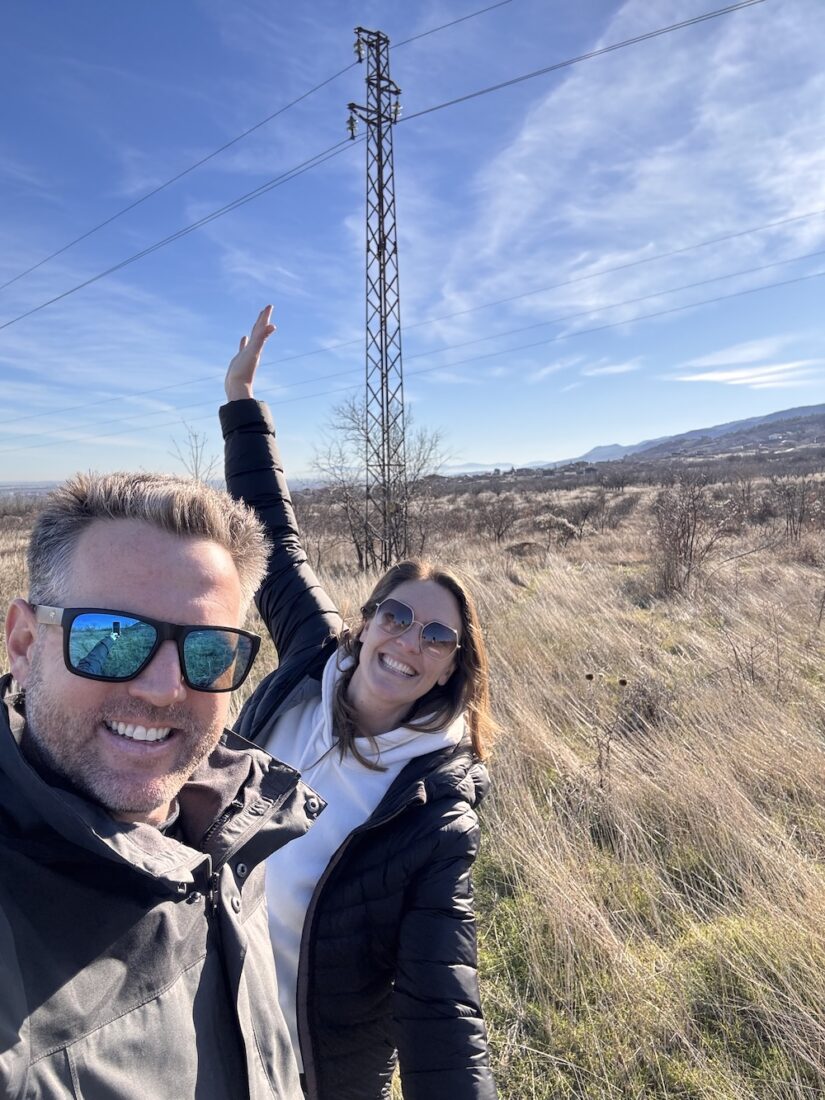
So we decided last minute to book a trip to Asia. We hadn’t been East since COVID… and we were really craving something different.
We booked our flights less than 2 weeks before flying out. We had to pack up our house, get in some last minute appointments, catch up on some work and we were off.
But what happened on this trip and the days leading up to it really surprised us.
From the minute we hit “book” on those flights… there was a welling inside of us. A feeling that we didn’t expect at all.
A feeling that maybe we forgot. And a feeling that might culminate in us changing our entire lives, surroundings, and business in the next few months.
Bali in particular seems to have some kind of power over us.
They say that this island is an “energy center”, and while I don’t know if that’s true… it does always seem to send ripples through our lives when we go there.
Before I get into that though, I want to share with you a little bit about the travels we did leading up to Bali.
It’s been a long time since us Goats have come on the blog just to share a travel update.
So let’s start with a good old fashion “travel blog post”. You know? Like back in the day?
The Reason For The Trip
Before we get into the trip, why did we even go?
It all started because some of our best friends, Vivien & Aaron (who we met while we were pet sitting in the Caribbean) were getting married in Australia.
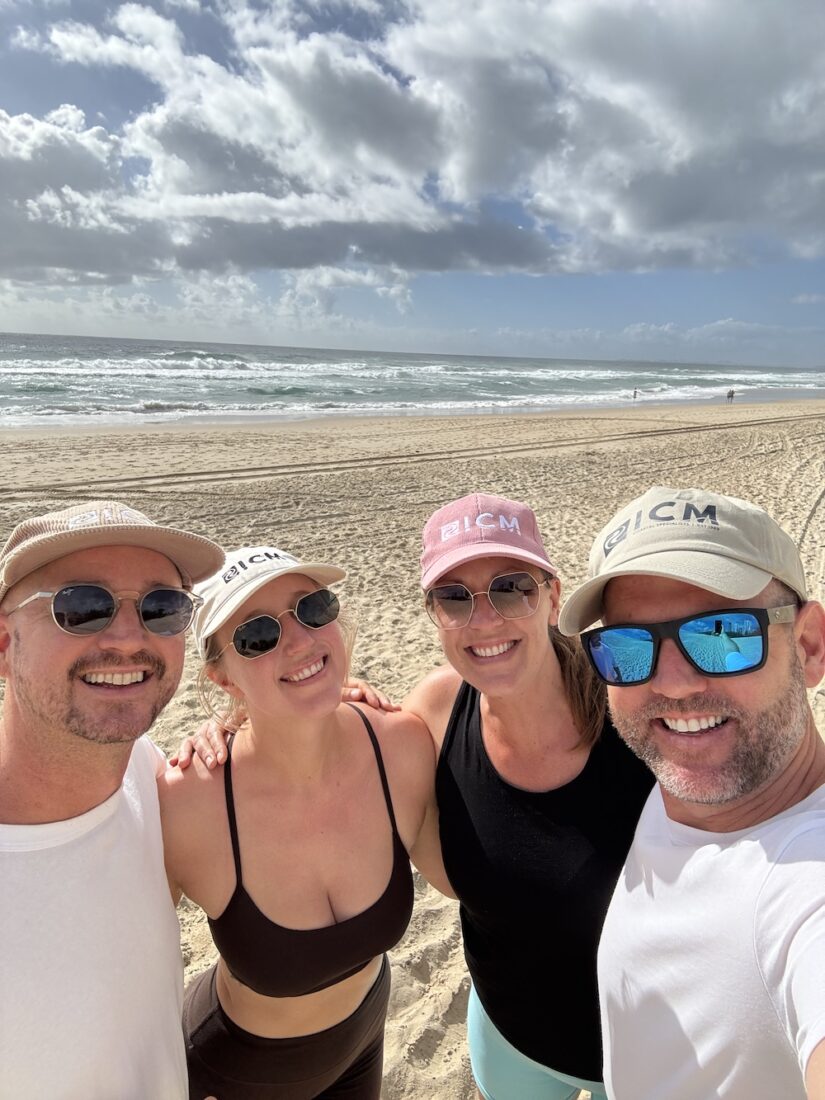
At first it was just going to be a quick 2 week trip over to Aus for the wedding and festivities, then back to Bulgaria.
But as anyone who’s been to Australia knows… it’s not close. So we figured… why not make a trip out of it.
That 2 week wedding trip quickly turned into 3 months+ as we kept adding new countries and destinations to the itinerary.
We decided we’d fly into Hanoi first because there was a great flight from Bulgaria to Hanoi.
Then we’d go to Taiwan because it’s a new country for us and only a short flight from Hanoi.
Then Bali to visit some of our other best friends, Tom & Anna… then onwards to Aus for the wedding.
And because you can’t go all the way down under and NOT go to New Zealand… we added that on too (plus New Zealand has some of the best fly fishing in the world… so you better believe half our luggage is full of my fishing gear).
And that’s when the trip went from being just about the wedding… to something entirely different.
It was about shifting gears. Stepping away from our familiar rhythm in Bulgaria and trying out the digital nomad life again.
Leaving Bulgaria
We’ve loved our time in Bulgaria. To us, the country is just entering what we call “The Goldilocks Zone”.
There isn’t so much tourism that the magical places are ruined, and yet there is enough that there is a good amount of amenities and international diversity.
There are great restaurants, both local and foreign, there is a growing community of expats, there are beautiful places that are yet to be discovered, and some up-and-coming hotspots that are just starting to get on the tourists maps.
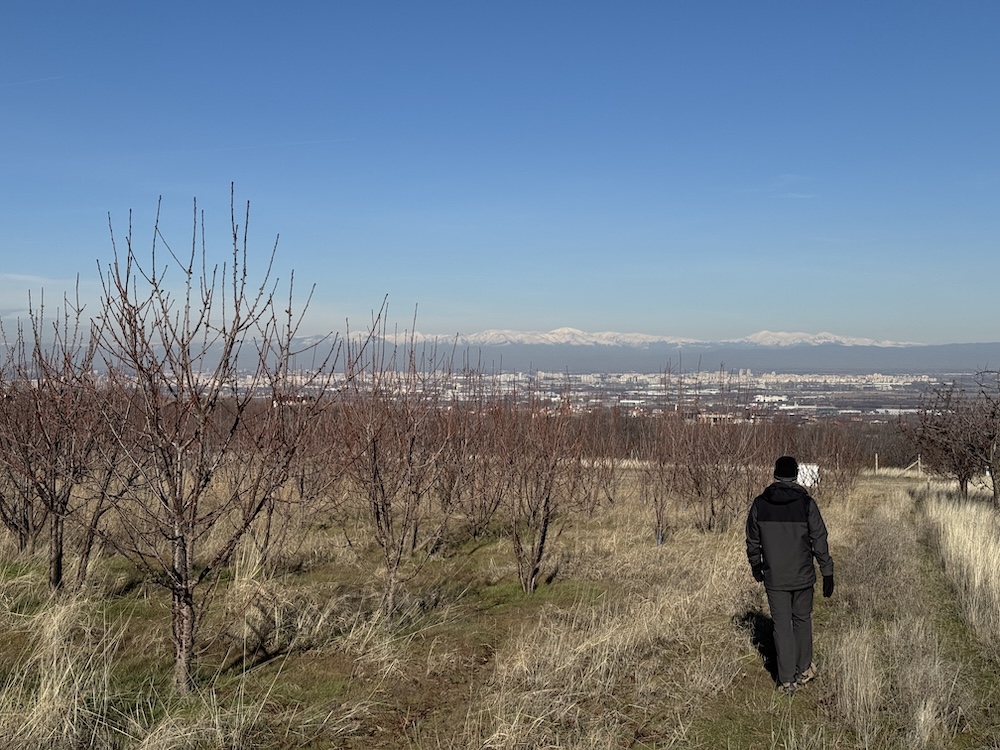
I love the mountains, the nature, and the incredible cuisine, which is a blend of Balkan, Mediterranean and Middle Eastern.
We have great Bulgarian friends and there is fantastic wine and fly fishing.
We also love it’s location. Right at the edge of Europe, Africa, and The Middle East, it’s surrounded by some of our favorite countries (like Greece and Turkey) as well as some we haven’t spent much time in yet like Romania and Serbia.
Plus it’s the perfect gateway to the rest of Europe.
In fact, it’s the location that’s kept us here for so long.
In the past 3 years that we’ve lived there, we’ve done plenty of trips.
In reality, we only really spend 6-8 months a year in Bulgaria.
The rest of the time we’ve been traveling around Europe, Mexico, the Caribbean, or back to Canada.
But that’s basically been it. And those countries and regions are so “easy”.
They’re beautiful. They’re inspiring. They have the history, the food, the friendly people, the natural beauty.
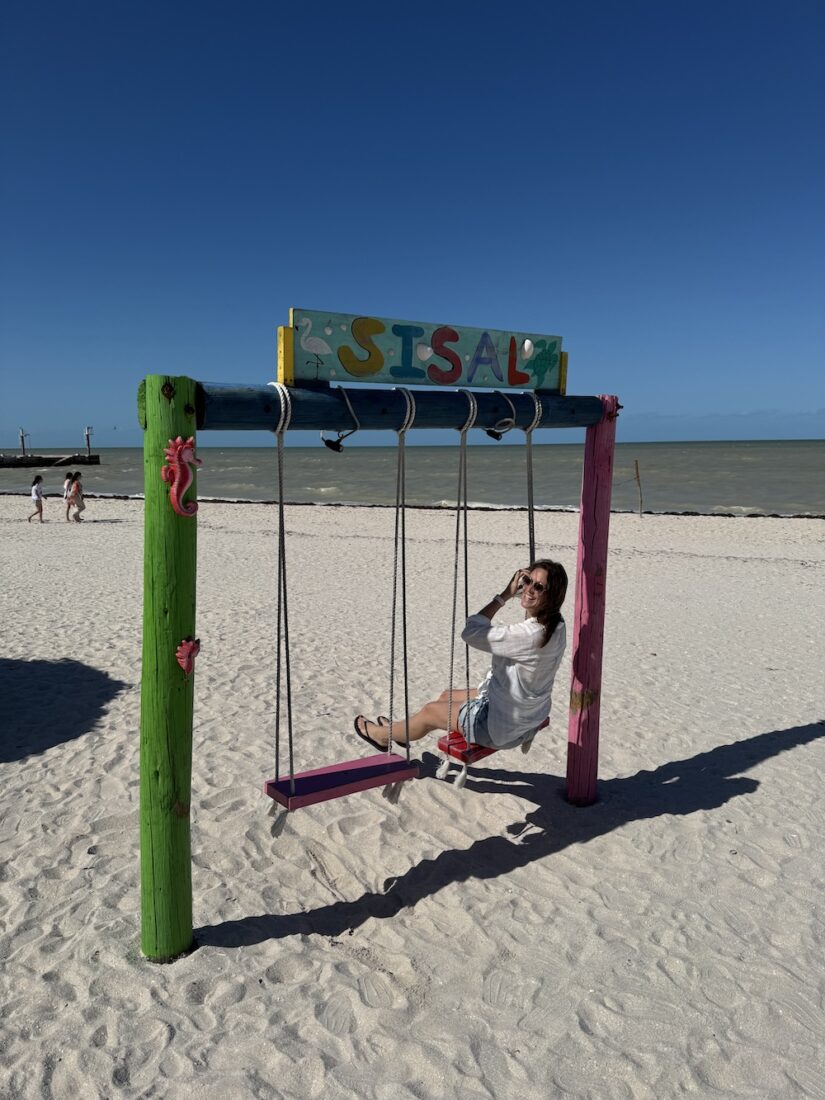
But they don’t have that one thing that we’ve realized was missing from our lives since COVID.
Culture shock.
That feeling of being slightly uncomfortable, slightly disoriented… where the language sounds different, the rhythms of daily life don’t quite match what you’re used to, and even simple things force you to be present again.
It’s the kind of experience that wakes you up – not just as a traveler, but as a person… reminding you that there are places that just move to a different beat.
So when we hit “book” on those flights to Hanoi, Vietnam… we had this new surge of energy.
I was almost gitty about getting back to Asia.
It felt like we were back in 2008 about to embark on our first ever trip.
I guess because it had been so long, I just felt like this was going to be an entirely new type of travel for us – even though we’ve spent over 5 years total traveling and living around Asia.
We yearned for the sound of Asian languages, the hum of motorbikes on the street, the taste of foreign spices and fruits, the feeling of sitting on plastic chairs with a cold bottle of beer in hand, people watching on the busy streets.
This is what Asia is all about. We were finally going back. Finally going to where all our travels began. Our nomadic “home”.
Landing in Hanoi
We landed in Hanoi after a 24 hour total flight day. It was only supposed to be a 12 hour flight from Sofia, but when we landed in Istanbul at 1am for our planned 1.5 hour layover… we got some news.
Our next lag was delayed for 5 hours!
There was nothing we could do but sit in the lounge for the next six and a half hours and try to get some sleep.
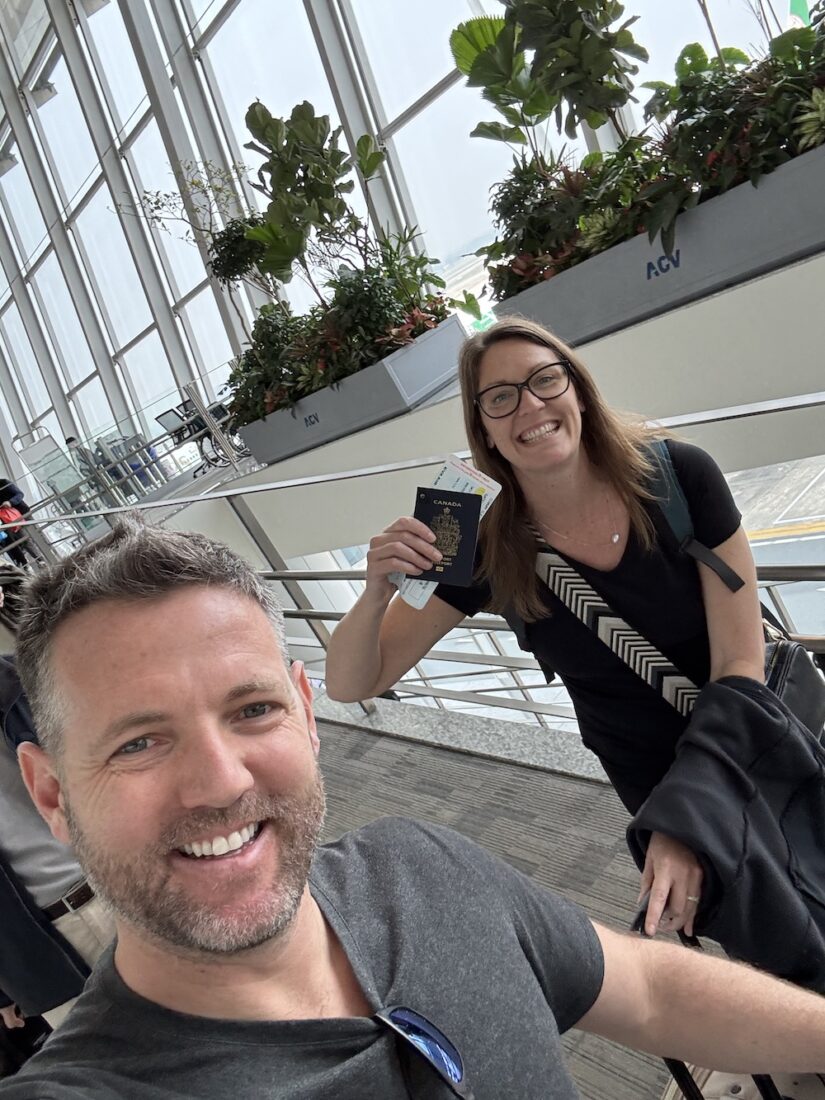
We did manage to get some sleep, and actually even though the trip ended up taking a lot longer than expected, when we landed in Hanoi we were immediately charged with a new energy.
We arrived at night (which we always try to do to avoid jet lag) and so we checked into our Airbnb and went right to sleep.
The next morning we woke up early feeling refreshed and ready to check out the city.
Stepping out of our apartment building and onto the street, I couldn’t shake my goofy smile.
I was grinning ear to ear as we pushed through a sea of motorbikes to cross the road.
I was smiling as we got our first vietnamese coffee and when we sat on our child-sized plastic stools to eat some mysterious and delicious street food.
And I was beaming when we got lost down a tiny alley for the first time and watched as the locals sat behind tiny metal tables, slicing fresh fish and arranging piles of herbs and vegetables for the afternoon rush.
It just felt like it was everything I had been waiting for for the past couple of weeks since we booked the flights.
Have you ever gone somewhere, done something, or felt a moment hit you where you suddenly thought… why has it taken me this long to do this again?
That was us in Vietnam. What took us so long to get back to Asia?
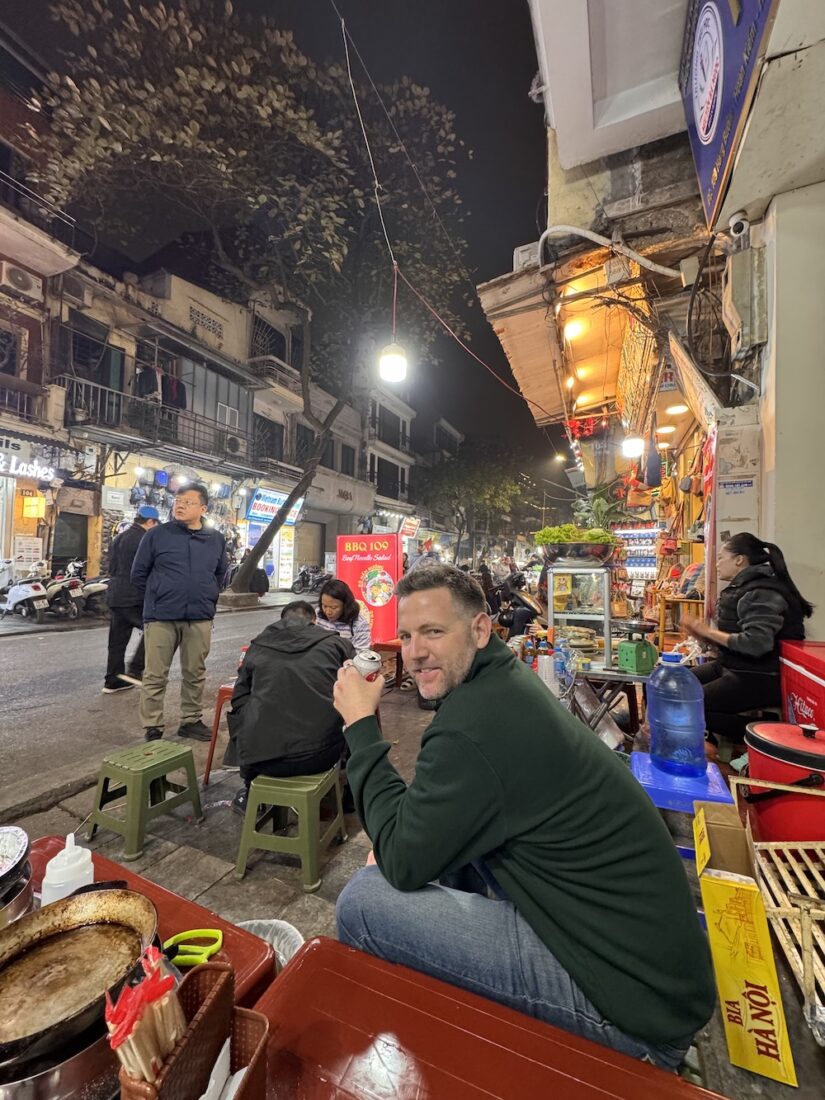
What took us so long to make it to Northern Vietnam?
We actually travelled to Vietnam on our very first trip. Back in 2008. It was our second country on the trip.
But shortly after arriving in Vietnam, Dariece got Dengue (or some other strange sickness) that rendered her bed-ridden for 10 days with a crazy high fever and no way to keep in fluids.
That delayed our trip, which meant we only made it as far north as Hue before our visa ran out. We always said we’d return, but it took us 18 years to do it!
In fact, 18 years almost to the day. We looked back at Dariece’s journal entries from that 2008 trip (yes somehow she still has them) and we realized that we left Vietnam 18 years ago on almost the exact same day as we were landing in 2026.
Crazy how the universe has these ways of drawing us back to places and the timing at which those things seem to happen.
Sometimes it feels quite serendipitous.
Halong Bay
Aside from wandering around Hanoi, eating incredible food, and meeting cool people, we knew we wanted to visit Halong Bay while we were in Vietnam.
This bay is a natural wonder of the world and a UNESCO World Heritage Site. It’s famous for its limestone karsts jutting out from emerald-green waters, creating one of the most surreal seascapes in Southeast Asia.
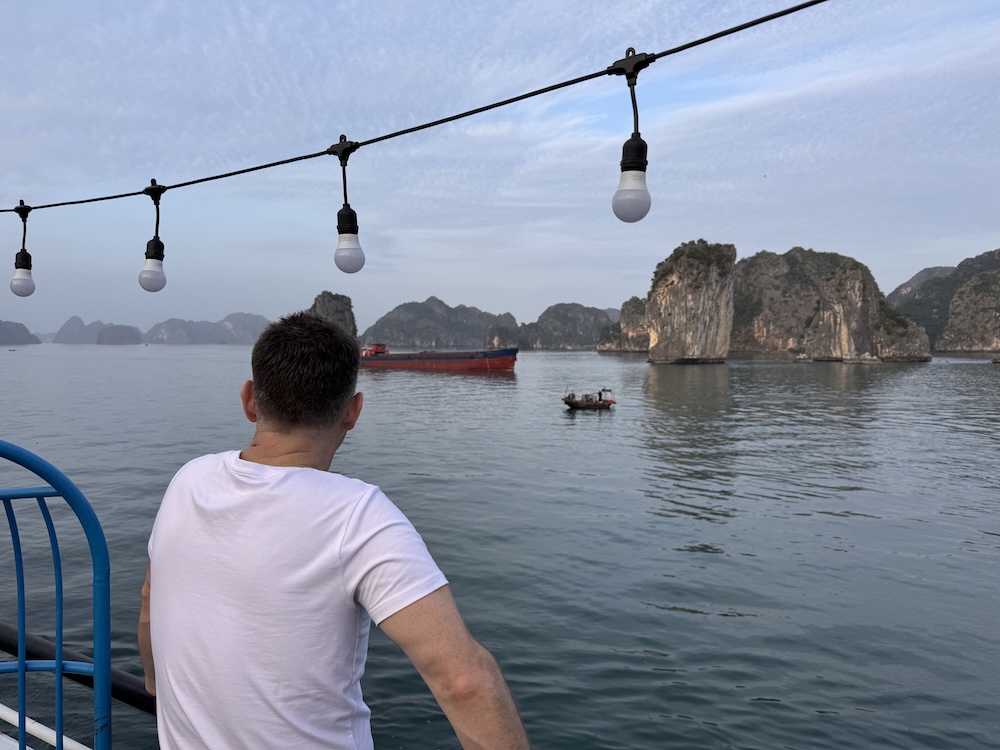
Cruises, yachts, and “junk boats” all ferry tourists around the islands and stop for snorkeling, sunset gazing, and squid fishing.
We’ve never actually done a cruise together, so we thought this would be a good time to splash out.
We booked a luxury cruise in a beautiful suite that had a king sized bed, a deck overlooking the sea, and a huge bathroom with a free-standing bath tub.
It was lovely! It wasn’t cheap, especially for Vientam, but none of the nicer Halong Bay cruise boats really are.
We paid $250 for the night including transport to and from Hanoi, all food and tours, kayaking, etc.
You can book the same one Here on GetYourGuide.
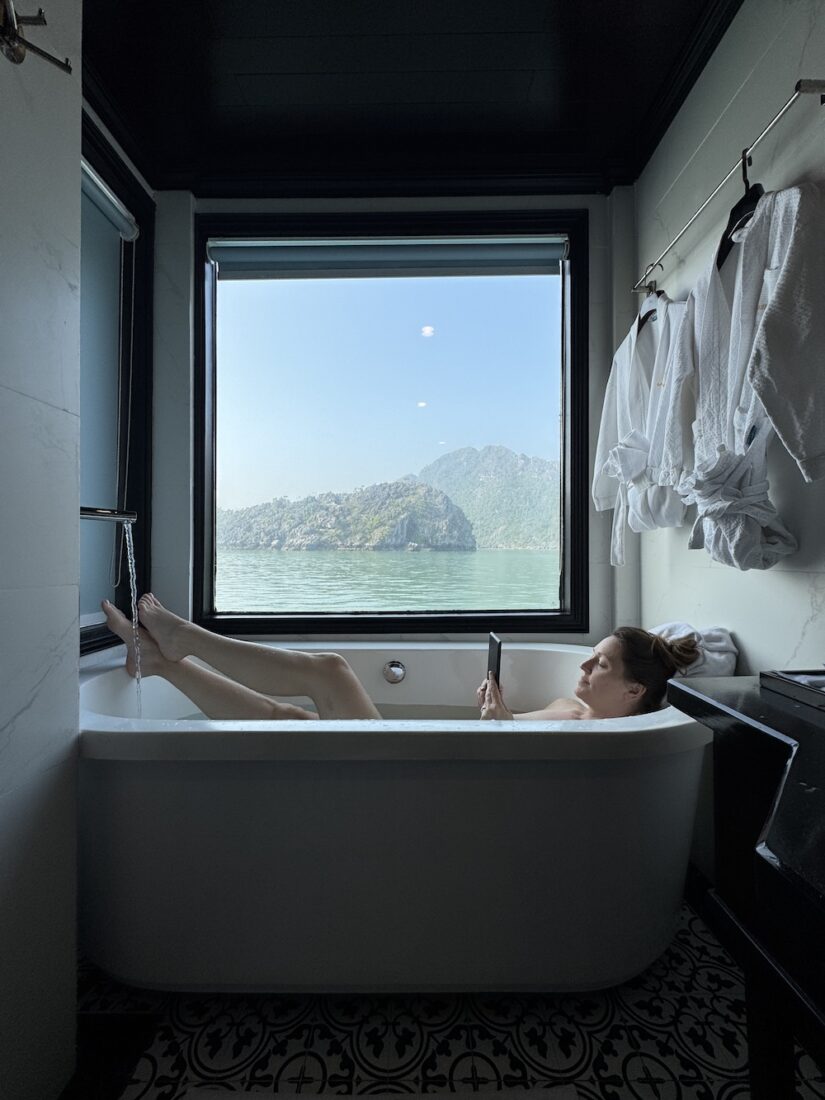
The trip was amazing.
While we had suffered through some of the coldest days on recent record in Hanoi (5°C / 41°F) and plenty of cloudy days and rain… as soon as we got to the boat the sky parted and 20°C / 60°F became the daily highs.
We spent a lot of time just chilling in our room on the deck looking out at the view.
But when we peeled ourself away from there, we’d go up to the top levels for delicious meals that were served by onboard chefs, or we’d be out on a kayaking trip or doing morning Tai Chi on the top deck of the ship.
I definitely would recommend that ship we went with, or at least visiting Halong Bay if you’re ever in Vietnam.
We had heard that there was a bunch of trash in the water that really took away from the experience, but our ship actually spent a lot of time in Lan Ha Bay.
I’m not sure if that bay is cleaner, or we just got lucky with currents, but we didn’t see any garbage besides one or two rogue plastic bags floating by in the water.
Heading to Taiwan
After a week in Vietnam, eating fantastic food, exploring the city, drinking at rooftop bars, listening to live music and cruising Halong Bay, we were off to Taipei.
We’ve been wanting to visit Taipei for years. And it was exciting to finally get to go.
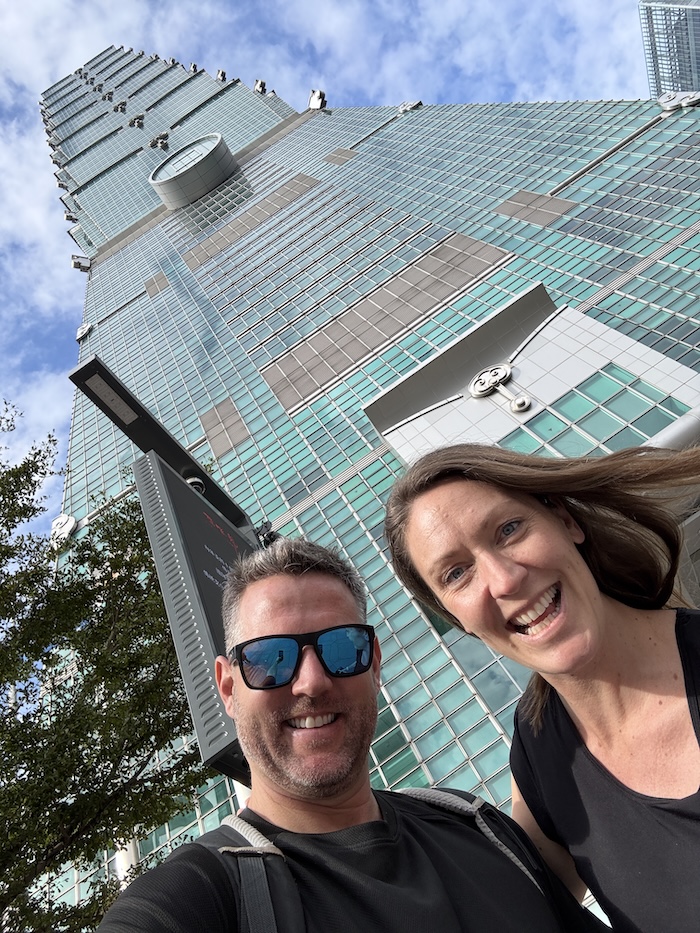
When we landed it marked my 82nd country and Dariece’s 83rd (she visited Dominican Republic with a girlfriend before we got together… I will catch up one day).
I have to say… were were both blown away by Taiwan.
Having lived in China for a year as English Teachers back in 2012-2013, we’ve always loved Chinese language, culture and … food.
Oh my god the food.
When we try to describe Chinese food to our friends and family who have never visited China, we always have to explain that Chinese food is nothing like the Americanized deep-fried cantonese fusion dishes that we get in the west.
It’s not all chow mein, sweet and sour pork, ginger beef, spring rolls and fortune cookies.
Although aside from the American invention of the latter, the other things can be found in variations in different parts of China… the real cuisine is so much more diverse and refined.
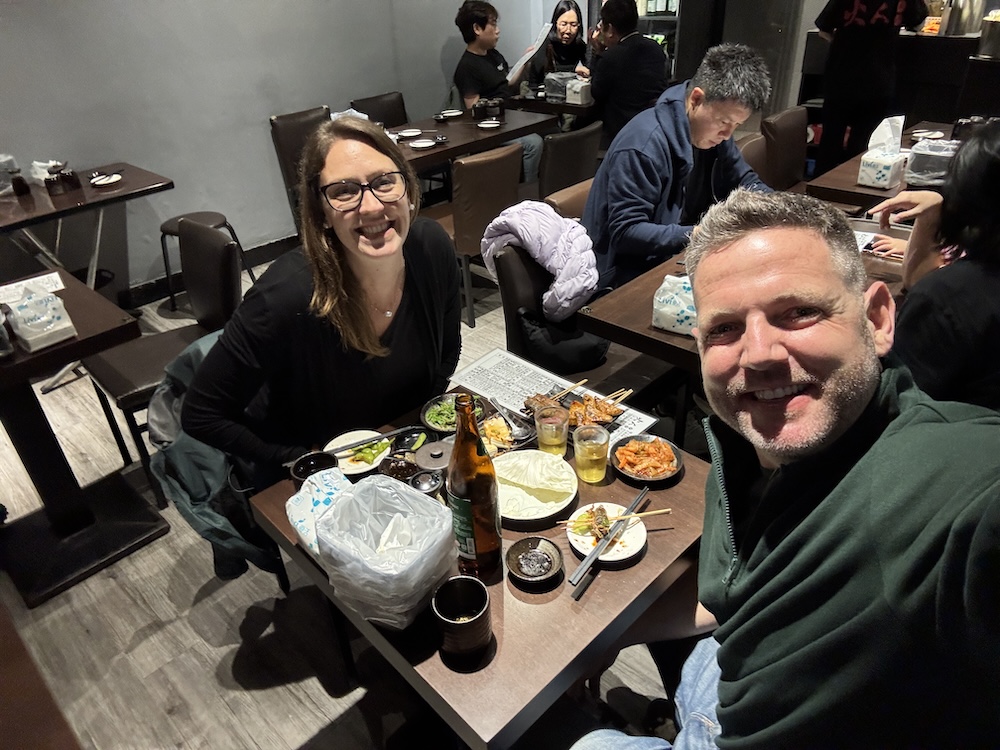
If you want to taste layers of bold flavors that light up your pallet, then you have to try real, authentic Chinese food.
Of course, because Taiwan has such a long history with China and Japan, there is an incredible meeting point of these two world class cuisines that makes for one of the most incredible food destinations on the planet.
Fusion comfort dishes like Taiwanese beef noodle soup (牛肉麵) are the star, but you’ll also find street food legends like xiao long bao (小籠包 – broth-filled soup dumplings), gua bao (割包 – Taiwanese pork belly burger), Taiwanese popcorn chicken (鹽酥雞), and scallion pancakes (蔥油餅), along with some more unusual local favourites like oyster omelette (蚵仔煎).
There are also plenty of homey classics like lu rou fan (滷肉飯 — braised minced pork on rice) and three cup chicken (三杯雞 – soy-glazed chicken traditionally cooked in a clay pot).
I honestly think I had the best meal of my life in Taiwan, or at least one of the best.
It was at this little hole in the wall restaurant known for it’s “award-winning beef noodle soup” and I ordered 3 dishes that blew me away.
The beef noodle soup, the ground pork wontons in a soy sesame glaze, and the congealed ducks blood (I know it sounds weird) were phenomenal.
If you’re in Taipei, don’t miss that restaurant.
Aside from hanging out in and around Taipei, we wanted to see a bit more of Taiwan so we booked a day trip on GetYourGuide that would take us to Shifen, Jiufen, and Yehliu.
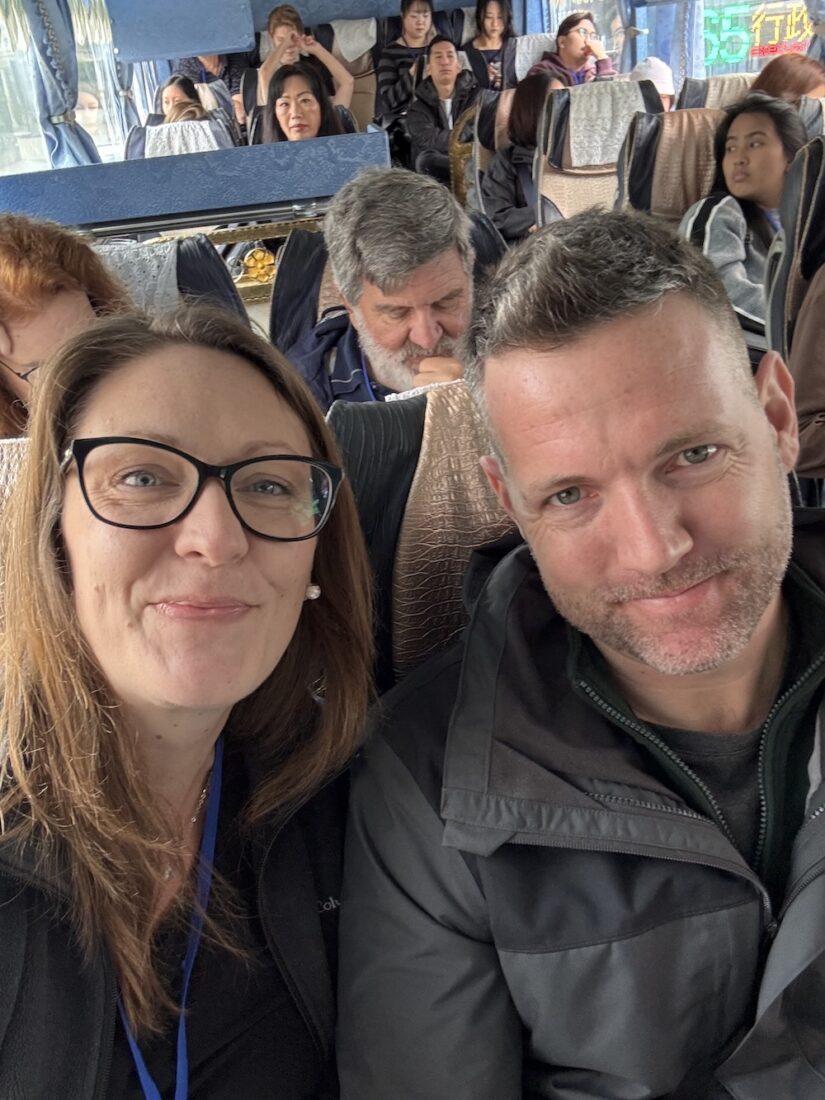
The destinations were fantastic, but the tour itself was absolutely terrible.
Normally we love GetYourGuide tours but this one we definitely don’t recommend.
We thought it was going to be a small guided group tour. When we arrived it was a massive bus of 50 people with only one guide.
You know these types of tours. The stick with the teddy bear on the end, the microphone, the whole bit.
The guide spoke English the entire time, and even though we’ve lived in China for a year, so are familiar with the accent, it was impossible to understand 99% of what was said.
On top of that, he didn’t give us ANY information. He just repeated the same things over and over again about 10 times before each stop.
He would simply repeat the time we were arriving, when we would leave, where the bus would be, and where the bathrooms were. Over and over again. For an hour before every stop.
It was so bad it was comical.
I’ll link the tour so you don’t make the same mistake we did:
https://www.getyourguide.com/taipei-city-l190/yehliu-jiufen-shifen-guided-tour-from-taipei-t496437
But like I said, the stops were beautiful.
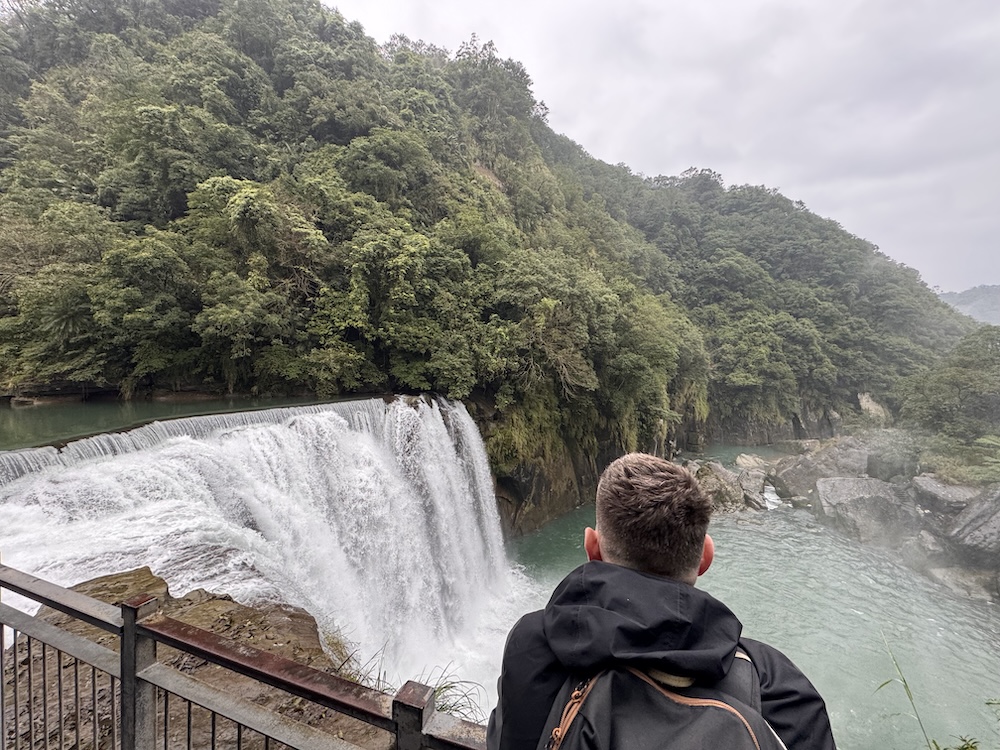
The stunning Shifen Waterfall surrounded by jungle clad hills, the town of Shifen with it’s Hanoi-like train street and Chinese lanterns, the mountainside old town of Juifen, and the beatiful rock formations of Yehliu.
I would definitely recommend checking this out on any trip to Taiwan, but just not on the above tour.
Taking public transport, a private driver, or even another GetYourGuide tour would be a much better option.
We really wanted to make it down to Taroko National Park as well but we just didn’t feel like we had time, plus some of the trails remain closed after a recent major earthquake.
South To Uluwatu, Bali
Every time we return to Bali we do it with a little bit of apprehension. Have our favorite spots been overdeveloped? How has this little island changed since our last visit?
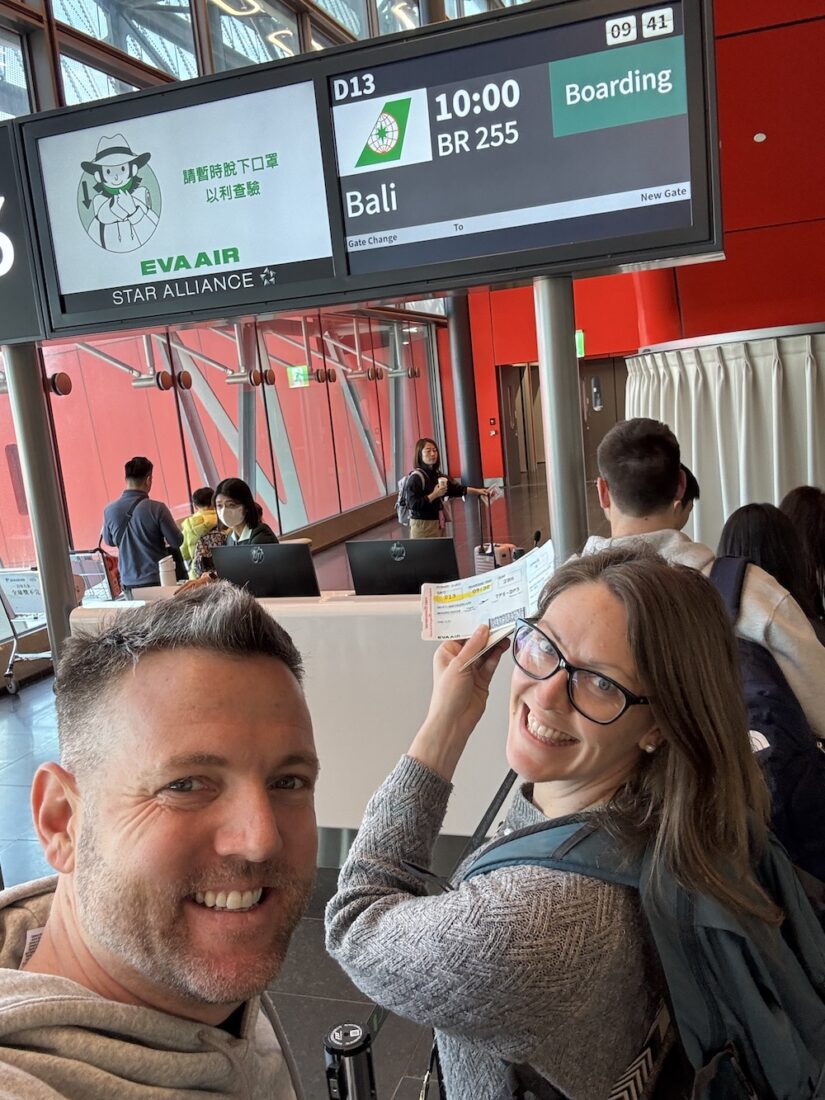
And every time we we return, we’re slapped in the face with contradicting feelings.
On one hand, we see the overdevelopment.
We see the traffic getting worse.
We see them cutting down once lush jungles that were home to elephants and tigers, or paving once vibrant green rice terraces with spas, gyms, cafes, and villas.
Bali is such a magical place, even today. But it’s flame is slowly being snuffed by overtourism, overdevelopment and a lack of regulation.
This is what we saw as we drove south from the airport towards Uluwatu. A 9 kilometer drive took us an astonishing 2 hours and 15 minutes thanks to the insanely dense traffic.
But as we neared Uluwatu, a cliffside surfer town, the traffic thinned and we started to see the charm of the place.
I would say Uluwatu is nearing the end of it’s goldilocks phase.
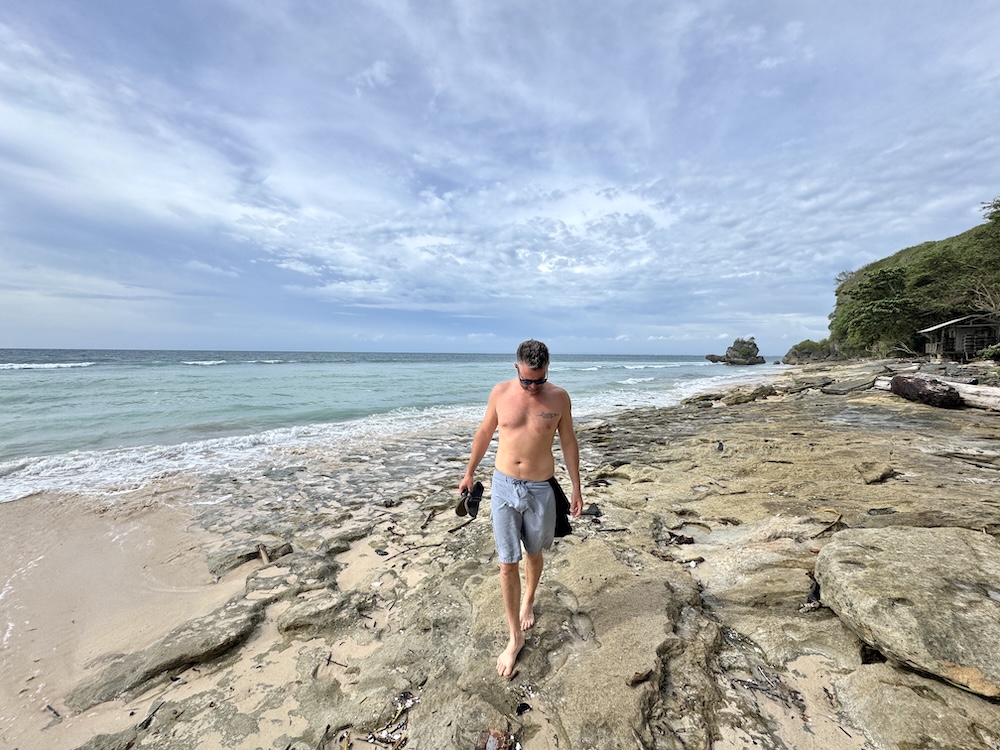
Just a couple of years ago this town was an up-and-comer. A quieter oasis miles from the chaos of Changuu, Bali’s most recent tourism casualty.
But now Uluwatu, or ‘Ulu’ as its often called, is in full swing.
Every mile of coastline has new villas, strip malls, restaurants, and spas being built. You can’t go anywhere in the town without hearing the deafening roar of construction.
And yet, when dodge traffic and walk along the sidewalkless streets, you can still see the beauty of this place.
It has everything you need. Bars, restaurants, health, wellness, beauty… it’s modern Bali life at it’s finest.
And while it may only have a couple of years left, currently it’s probably the best place in South Bali to visit.
As digital nomads, what struck us about Uluwatu was the lifestyle for people like us.
Our friends, Tom and Anna just bought a stunning villa there, so were were thrilled the get to stay with them for a few nights.
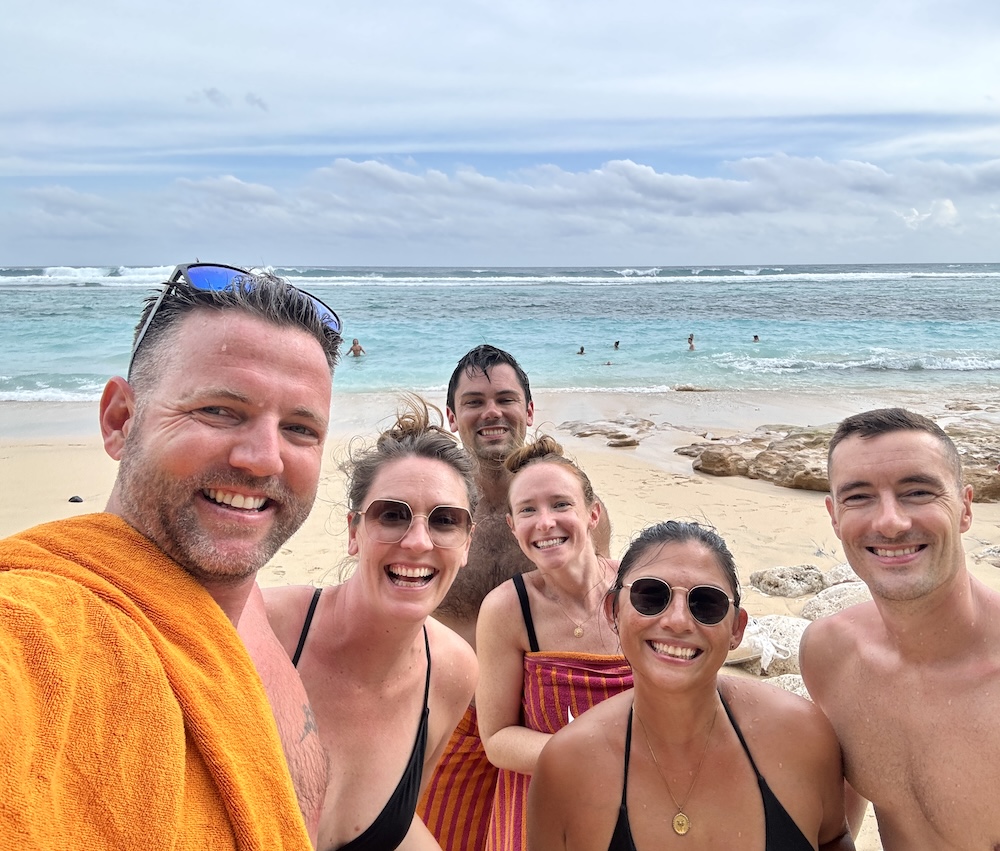
 ) Bridgett & Robby
Their location was down a quiet back street, and while there was still construction, it was far from the traffic of the main center of Uluwatu known as Bingin.
Their villa was beautiful, but what we were really inspired by was the lifestyle there.
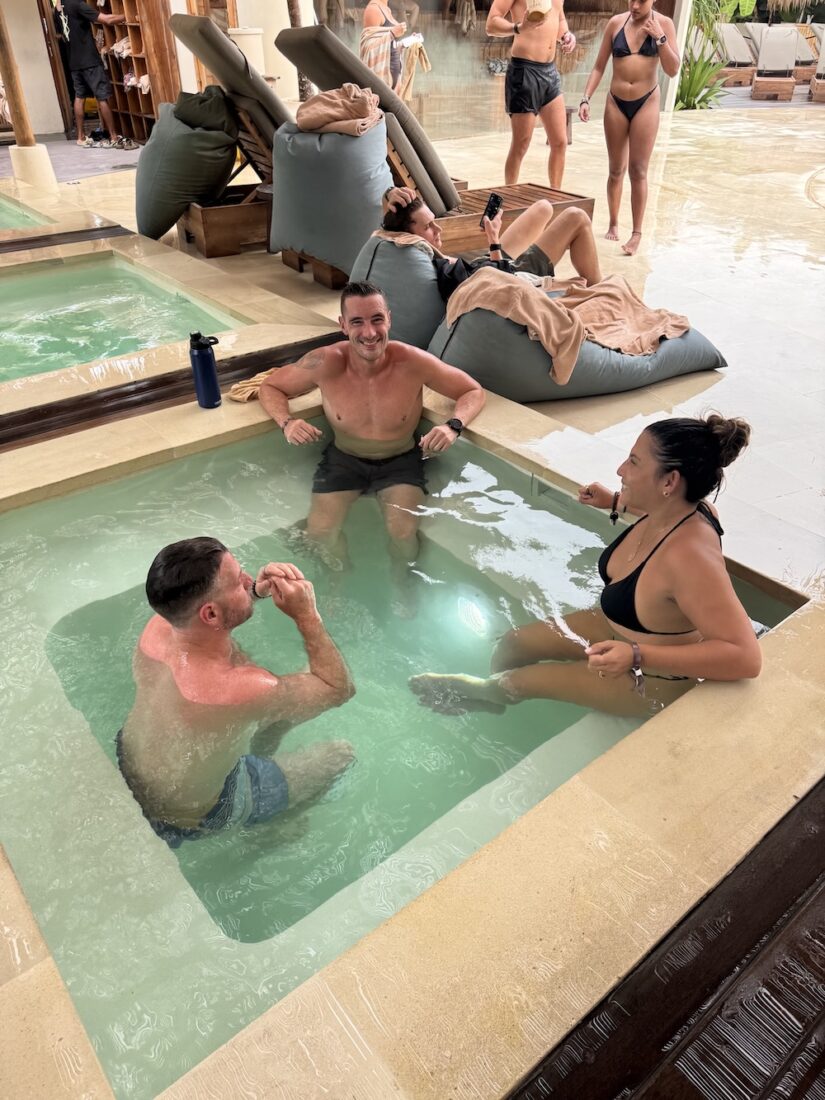
Morning coffees and coworking followed by spas, cold plunges, saunas, the gym, a massage, a bit more work, sunset drinks and then dinner at one of the many delicious restaurants in town.
It was amazing. There was community, inspiration, health, beauty, the ocean… everything that someone needs to be happy.
And it really got us thinking about why we went into this life in the first place.
Yes we love Bulgaria, and we love our life there too.
We especially love our house – a large two story house at the foothills of the mountains with a nice car, a big back yard, and plenty of good hiking and fishing nearby.
But what it doesn’t have is the community. It doesn’t have the ammeneties. We can’t just go to a spa / gym with 3 different temperatures of cold plunge, a health resaurant, and a sauna.
We can’t join morning yoga classes on the ocean or do breathwork retreats surrounded by rice paddies.
On top of that, the Balinese people reminded us how great hospitality can make you feel welcome and even brighten your day sometimes.
The Balinese people, despite the obvious negative affects tourism has had on the island, still treat us like honoured guests.
They go out of the way to help us. They always greet us with a smile, and they’re genuinely interested in where we’re from, what we’re doing, why we’re in Bali and always… where we’re going next.
Bulgarian people are some of the coolest people I’ve met. Our friends, our neighbours, the people we know there, they’re just really great people… once you get to know them.
But the service industry in Bulgaria is still growing and there are plenty of times you will get really poor service when you’re out for dinner or lunch, and it’s not customary to greet people with a smile there, which can come off as “grumpy” to some visitors.
We definitely know better, but it was still amazing to feel the genuine kindness from strangers in Bali who would just wave at us as we walked by, or stop and talk to us for no reason.
These things all added up to make us really think about spending more time outside of Bulgaria in the coming years.
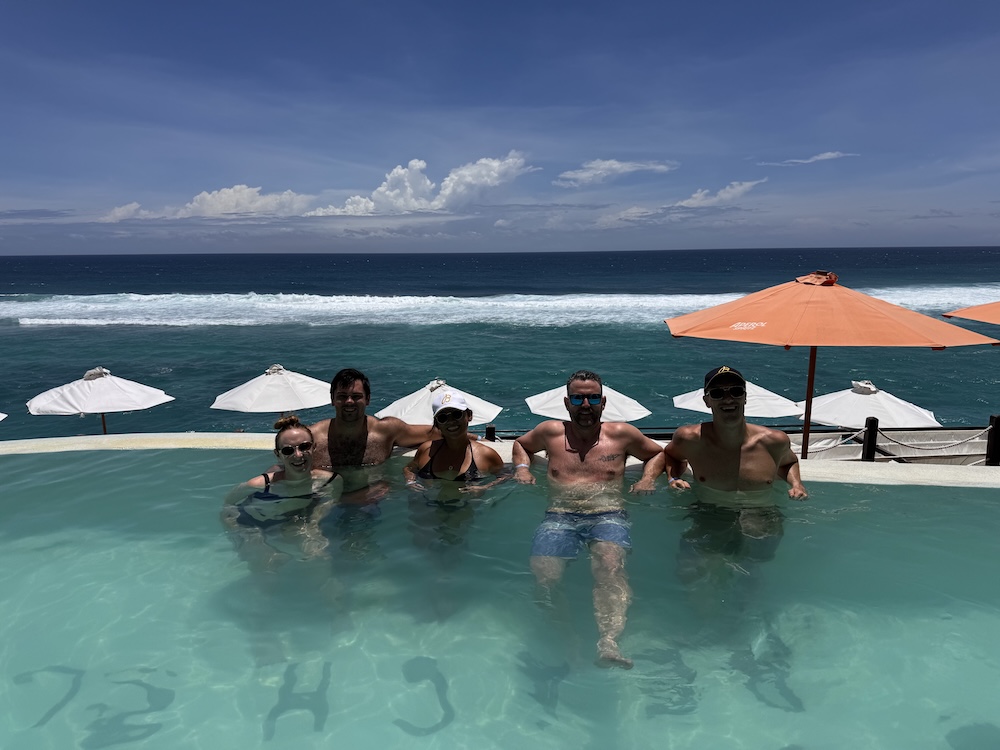
We don’t want to move away from Bulgaria, we still love it there, but we want to live more of a digital nomad life.
One where we go to Bali for a few months every year, and maybe we spend some time in different parts of Asia like Vietnam and Thailand.
We loved working from cafes, meeting up with other entrepreneurs, going for massages and just living the nomad life that’s really only available at that level in Asia.
Our 5 Night Staycation in Bali
Instead of staying in the busy South of Bali the entire time, we wanted to get up north where we were hoping to still catch some of Bali’s magic… and we were blown away.
Going north brought us right back to 2009, the first time we ever visited Bali, and we were so happy to see that the island has retained some pockets of its former glory.
Ubud
The first stop was Ubud. The location of the Indonesia part of Eat Pray Love (we watched that movie again from our villa there).
A LOT has changed in Ubud since that movie was shot, and since we visited a few years prior to its release.
The center of the village is now bumper to bumper traffic, honking horns, vehicle fumes, and zooming motorbikes snaking their way through the cars and large trucks.
But we did find a couple of nice back streets that still had some Ubud energy to them, although between the warungs were countless ramen, smashed avocado cafes, matcha shops, and gift stores.
All the things that us tourists apparently need to have anywhere we go.
But what really blew us away about Ubud was where we stayed. About 10 minutes north of the city by bike, our private pool villa was set on the edge of the rice paddies.
Owned by a local Balinese man who grew up in Ubud and then built the villa after spending 10 years working in hotels in the USA, this place was probably one of the nicest Airbnbs we’ve ever stayed at in our lives.
A perfect blend of Balinese architecture, modern touches, and nature, it was so beautiful that we didn’t want to leave.
The infinity pool looked over the rice paddies, there was a kingsized bed, a full kitchen, and an open air bathroom with a free standing tub, a massive mirror, and a shower that looked like it was coming out of a jungle wall.
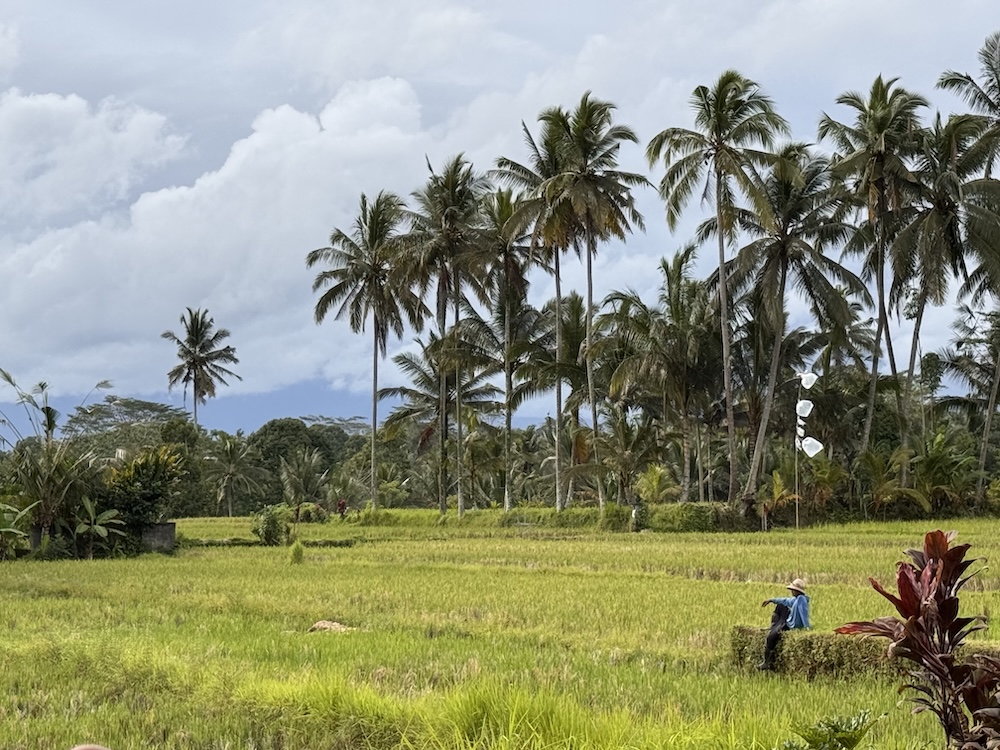
But what made it so special was the view. Because it didn’t just overlook one rice field, like so many Ubud villas – it looked out over an vista of rice paddies and palm trees.
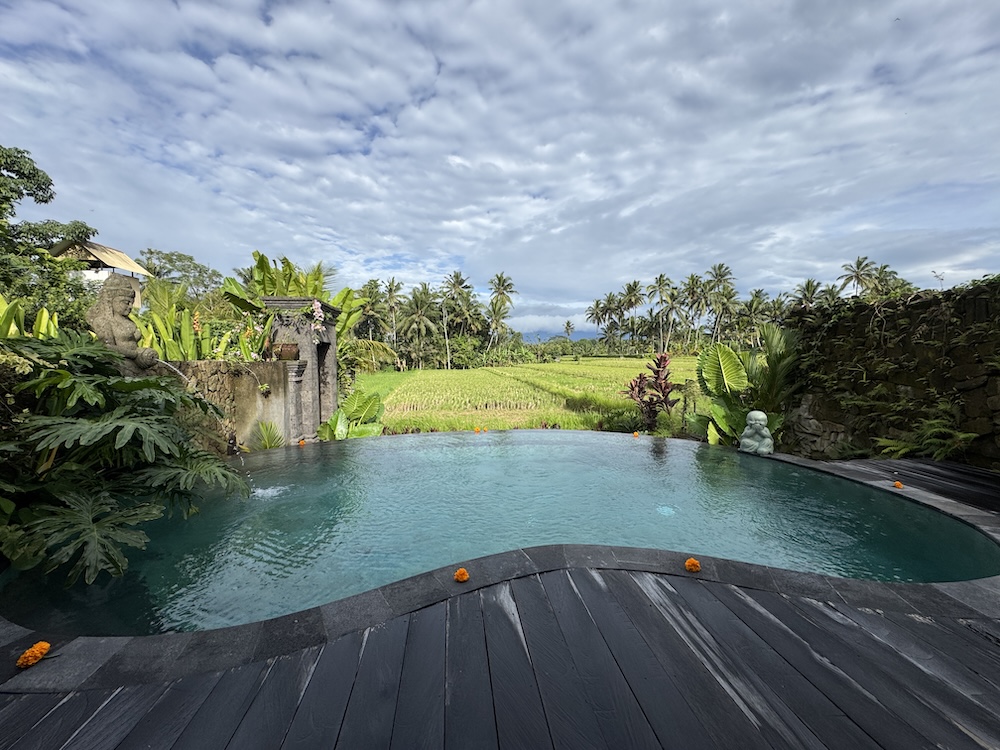
Because the owner of the villa also owned the land in front of it, the view of the rice terraces was expansive.
There was islands of jungle, then more rice, then some palm trees, then further off more rice, and Mount Agung in the distance.
It really felt like the Ubud we remembered. So we spent most of our time there, and little time in town, aside from visiting with our friends Jen & Stevo for lunch, who we taught English with in China many years ago.
Stepping Back in Time in Sideman
After Ubud, we headed to Sideman. This place is famous for its rice terraces. While Ubud is slowly filling its rice fields with cement to build villas and hotels, Sideman is what Ubud was 20 years ago.
The daily life here still revolves around farming.
There are of course villas and hotels popping up everywhere and yes, even here the sound of chainsaws, hammers, and metal grinders is hard to ignore… but it’s almost silenced by the beauty of the area.
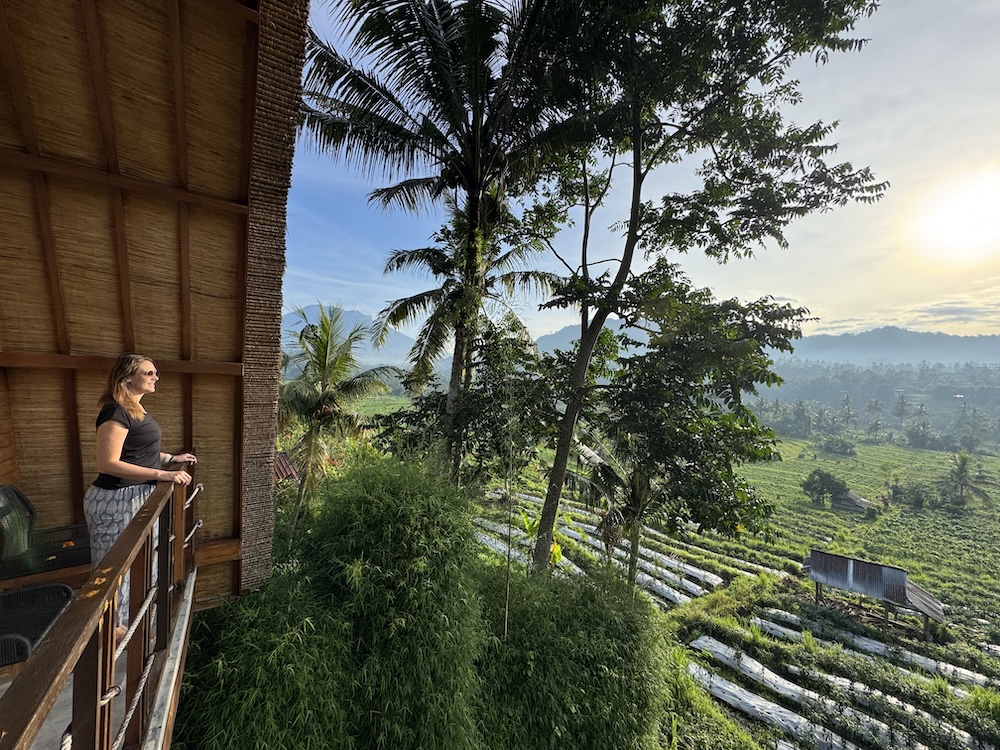
I can’t even explain this place and the videos and photos really don’t do it justice.
It’s so serenely beautiful that every time we looked out of the window of our 2 level “barn” apartment, it felt like someone had turned on an Ai image of the landscape.
It just didn’t look real.
Mount Agung loomed dark beneath a blanket of clouds, while a winding river spilled from its foothills, carving through the deep valley below.
On either side of the rushing river, emerald hills rolled into the distance – broken only by the occasional palm or banana tree standing beside tiny bamboo-thatched farmer huts.
We spent hours walking through the rice fields which, because of the season of our visit, were actually planted with marigolds, corn, and peanuts between harvests.
It was absolute bliss. Walking through the uninterrupted fields of green we were given hope again that some of Bali’s magic has remained unchanged.
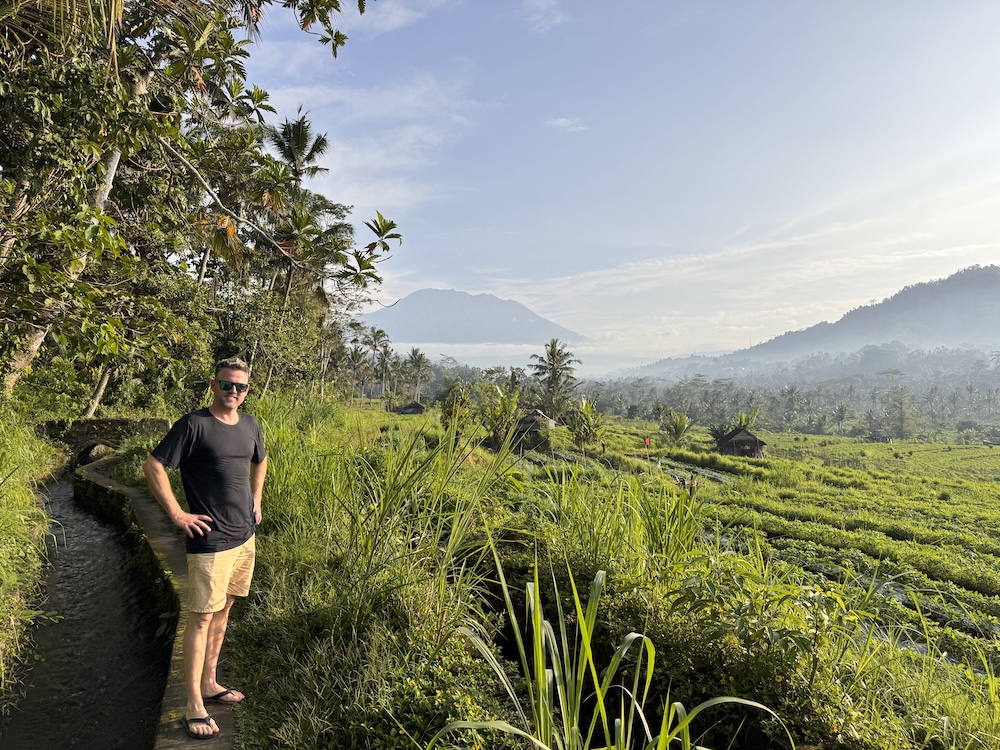
Sideman was like a time machine, transporting us right back to our backpacking days nearly 20 years ago when the Island of Bali was more jungle and rice terraces than it was strip malls and beach clubs.
Again we were talking about what it would be like to spend more time here. Maybe spending a few months in Uluwatu but taking more of these “staycations” to Ubud, Sideman, the deep jungle oasis of Munduk or the coastal calm of Candidassa.
Bali really does still have it all in so many ways.
Where do we go from here?
Geographically, after Bali we continue this 3 month adventure in Australia and then New Zealand, but beyond the map, this trip has left us with some bigger life questions we’re still trying to answer.
Do we want to keep living in Bulgaria for 6-8 months per year, or do we want to get back into a more digitally nomadic lifestyle.
Most of the members of our Remote Goats Community are building their businesses so that they can become digital nomads. That’s the ultimate goal for so many.
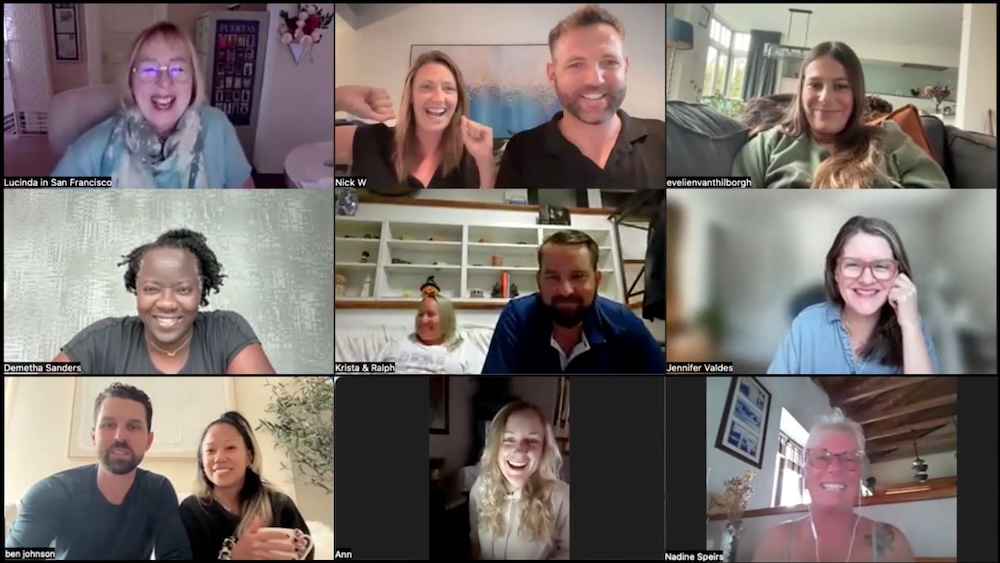
Have we been squandering it by living in one place so long?
Even though we’re over 40 now, there’s still a draw for that lifestyle. It’s always so exhilarating spending a few weeks or a few months in a place, and then moving on.
Getting to know a place. Having a group of friends. Being in an entrepreneurial hot spot. These are all things that we kind of miss living in Bulgaria.
Maybe we’re not fully ready to pack up and move yet, but what I do know is that this trip, and Bali in particular has planted a seed.
Something is growing inside of us and I think the Goats might be back on the road again soon.
We honestly aren’t sure yet… but what we do know is that this trip has been incredible so far, and we’re excited to see what the next few weeks has in store.
The post The Feeling We Forgot… Until This Trip Brought It Back appeared first on Goats On The Road.